Brownstone and limestone cleaning: why pressure matters
The stone that gives a New York block its character is also the stone most easily ruined by a heavy-handed wash.
October 19, 2026 · 4 min read
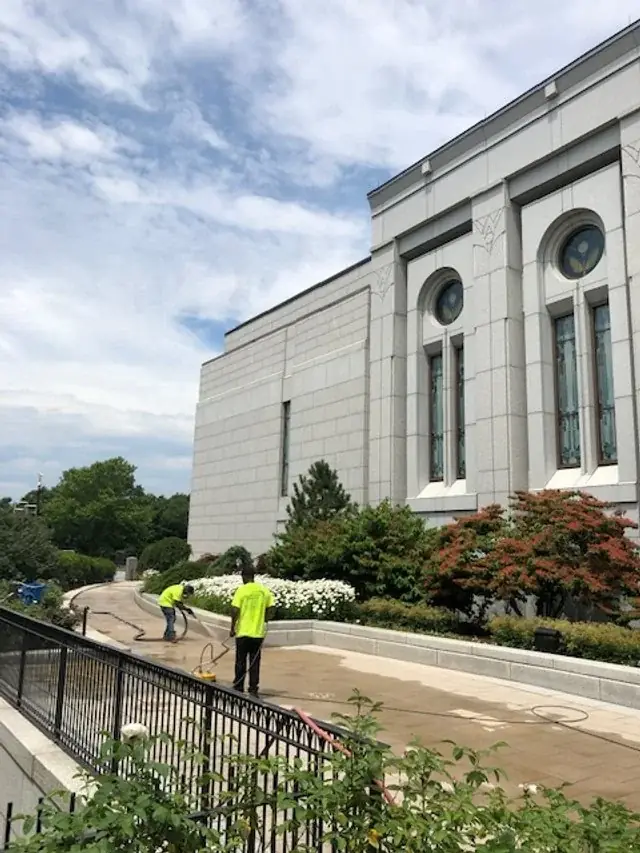
Walk any older block in Brooklyn, Harlem or the Upper West Side and you're looking at stone that has been taking the weather for a very long time. Brownstone stoops, limestone lintels, carved cornices and worn stair treads are what give those streets their character. They're also the surfaces most likely to be harmed by well-meaning cleaning. If you own, manage or sit on the board of a stone-fronted building, a little understanding of how the material behaves will help you hire well and avoid expensive mistakes.
Why these stones are softer than they look
Brownstone is a sandstone, made of grains of sand held together by natural cement. It looks solid, but the face of the stone can powder or flake when it's been weakened by moisture and age. Limestone is softer still, and it's porous, so it drinks up water, soot and pollution and holds on to them. Both stones can look uniformly dark and tired from a distance, yet each carries a delicate outer surface that took generations to form.
Hit either one with a hard, tight jet and the damage is immediate and permanent. Pitting, streaking, lost carving detail and a rough, fuzzy surface that collects dirt faster than before are all common results. There's no undo button for stone. That's why the pressure matters far more than the machine.
Gentle does not mean ineffective
The goal on historic stone is to let the cleaning agent and the water do the work, not the force. A careful crew starts with a pre-treat, applying environmentally friendly detergents that loosen soot, biological growth and surface film. Given time to dwell, those agents release the dirt so the rinse can be low pressure and wide, rather than narrow and aggressive.
Water temperature helps too. Power Washing NYC works with steam, hot and cold water, so a crew can choose the gentlest option that still lifts the grime. Steam, for example, can soften stubborn deposits without leaning on pressure at all. On the most delicate surfaces, soft washing at 300psi or less is the standard approach, because it cleans without risking damage.
What to watch out for in a contractor
Be cautious of any crew that treats stone like a driveway. Warning signs include a promise to blast everything clean in an afternoon, no mention of testing a small area first, and a single nozzle for the whole job. Strong acid-based cleaners are another worry on limestone, which reacts to acids and can etch, so ask what products will touch your facade and why.
Ask also about the joints. Old pointing between stones is often softer than the stone, and a hard jet can scour it out, leaving gaps for water to enter. Water behind a stone face is the beginning of bigger repairs: frost damage in winter, stains from inside, and spalling that no amount of cleaning will reverse. A good contractor will look at the pointing before washing and tell you honestly if something needs repair first.
Planning the job on a real building
Stone facades in this city rarely come with convenient access. Stoops, bay fronts, tall brownstones and limestone entrances may need a lift or careful ladder work, and the plan should account for windows, planters, iron railings and neighbors. Rinse water also needs somewhere to go. Water reclamation is one of the capabilities Power Washing NYC can bring when runoff is a concern.
Expect a sequence rather than a single pass: protect the openings, pre-treat, allow dwell time, rinse gently from the top down, then inspect in good light. Stone often looks different wet than dry, so a good crew checks the results once the facade has dried instead of declaring victory under a hose. Ask to walk the finished front with the crew, and point out anything that looks uneven while they're still on site.
After the cleaning
A freshly cleaned stone front can be a surprise. Years of soot come off and the real color of the stone returns, sometimes warmer, sometimes paler than anyone remembers. That is the point, and it often makes the block around it look worn by comparison.
To keep it that way, look at drainage. Leaking downspouts, failed gutters and splashing water at the base of a wall are the usual causes of fast re-soiling and green streaks. Fix those first and the cleaning lasts longer. Power Washing NYC also handles downspout and gutter cleaning on residential properties, which keeps water moving away from the stone where it belongs.
For brownstone and limestone cleaning and restoration across New York, call Power Washing NYC at (917) 671-9500 for a free quote. The crew serves all five boroughs, Westchester and Long Island, and will tell you plainly what your stone can take.
Power Washing NYC, (917) 671-9500
Call (917) 671-9500More articles
Reasons to hire a professional pressure washing company
A rented machine looks like the cheap shortcut, but the city's brick, stone and old mortar punish a heavy hand.
What to look for in a pressure washing service near you
Anyone can buy a machine and print a flyer, so here is how to tell a real crew from a risky one before the hose comes out.