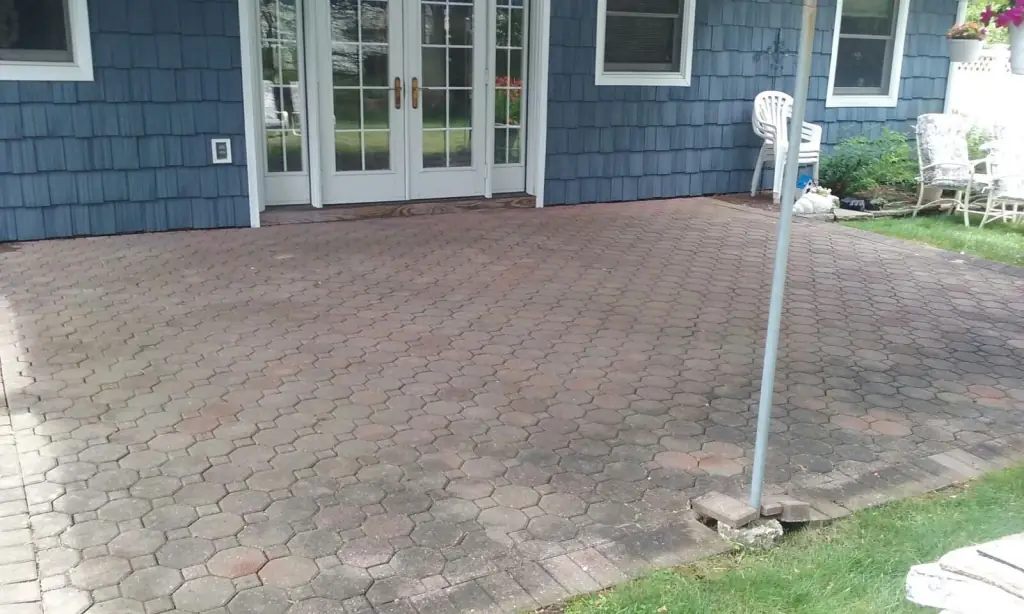
Why pavers turn green, grey and gappy
A paver is a porous stone or cast block set on sand, and almost everything that lands on it stays there. Algae takes hold in the shade of a rear garden or the north side of a house and turns the surface slick and green. Road grime, leaf tannin and the oil that drips off a parked car settle into the face of the stone and darken it in patches.
The joints fail next. Sand between the pavers washes out in heavy rain and gets blown out by years of sweeping, which leaves open seams where weeds root. Once the joints are low, the pavers lose the lateral support that keeps them locked together, and edges begin to lift and shift under foot traffic and tyres.
That is the usual picture on Brooklyn and Queens garden patios, on stoop-side walks in Manhattan, and on the paver driveways that run up to ranch houses across Westchester and Long Island. The colour is still in the stone. It is buried under a film that needs to come off before anything else is done.
Clean the face, refill the joints, then seal
The crew starts by pre-treating the surface with environmentally friendly cleaning products so the growth and grime are loosened before any pressure is applied. That matters on pavers, because pressure alone chases dirt into the pores and can scar a stamped or tumbled face. Water pressure is then matched to the paver, and steam or hot water is used where oil needs to come out rather than just move around.
Weeds and spent sand are cleared from the joints as part of the wash. When the surface is dry, the joints are refilled with fresh sand so the pavers are locked in again and the pattern reads clean from edge to edge. The before and after is usually most obvious here: a patio that looked uniformly dingy shows its real colour and its real pattern once the seams are crisp.
Sealing comes last, once the paver is clean and dry. A sealer protects the colour and helps hold the joint sand in place, so the next round of rain and foot traffic has less to work on. Which finish suits the job, matte or enhanced, depends on the stone and how you use the space, and we settle that when we quote.
Keeping a sealed paver looking sealed
Sealer is a coating, and coatings wear. Driveways take tyres, salt and oil. Patios take sun, furniture and shade moss. How soon a surface wants resealing depends on that exposure, so there is no honest single number, and we would rather tell you what we see on your pavers than quote a schedule off a chart.
A good habit is to rinse a sealed patio once or twice a season and keep an eye on the joints. If water stops beading on the surface or green starts creeping back into the shade, that is the cue to book a refresh rather than waiting for the full set of problems to return.
To get a quote, send the address and a photo of the paving, or call (917) 671-9500. Quotes are free for residential and commercial work, and the crew covers Manhattan, Brooklyn, the Bronx, Queens, Staten Island, Westchester and Long Island.